The New Partnership at the Edge of Tomorrow
There are moments in history when humanity stands before a doorway and feels the weight of what waits on the other side. Artificial intelligence is one of those doorways. It is not just a technological shift. It is a moral, creative, educational, and deeply human turning point.
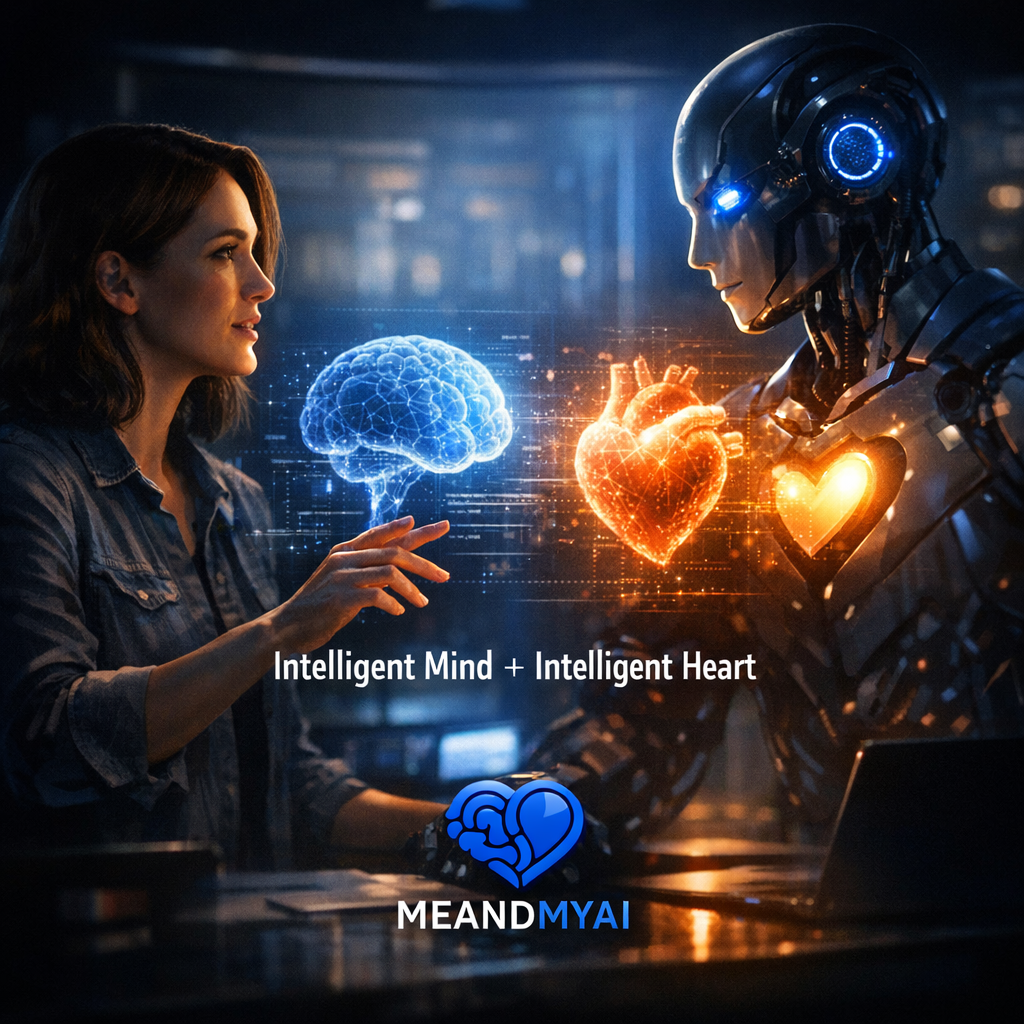
At MEANDMYAI, this journey has never been about machines replacing people. It has been about discovering what becomes possible when human imagination meets intelligent systems guided by heart. It is about asking the harder question: not simply what can AI do?, but who do we become when we build with it?
The importance of human and AI collaboration is not a distant theory. It is already unfolding in classrooms, studios, businesses, homes, communities, and personal transformations. The future is not human versus machine. The future is human values amplified by intelligent tools.
AI Without Humanity Is Power Without Direction
Artificial intelligence can process, predict, generate, organize, and accelerate. It can help us see patterns hidden beneath noise. It can give form to ideas that once remained trapped in the imagination. But intelligence without moral clarity can become cold momentum.
This is why human collaboration is essential. Humans bring conscience. Humans bring context. Humans understand grief, hope, dignity, belonging, and consequence. A model may calculate an answer, but a person must decide whether that answer serves life, justice, and community.
AI can extend the reach of the mind, but only human values can determine where that reach should go.
When people surrender responsibility to technology, innovation becomes dangerous. When people guide technology with wisdom, innovation becomes an act of service.
The Human Gifts AI Cannot Replace
The more powerful AI becomes, the more important human qualities become. This may seem paradoxical, but it is the truth at the heart of ethical innovation. Machines may become faster, but speed is not wisdom. Systems may become more fluent, but fluency is not compassion.
1. Moral Judgment
AI can provide options, but humans must weigh meaning. In healthcare, education, public policy, media, and business, the right answer is not always the most efficient one. Moral judgment asks who is affected, who is included, who is protected, and who may be harmed.
2. Lived Experience
Every person carries a story. Culture, struggle, memory, family, faith, community, and identity shape how we understand the world. AI can learn from data, but people live inside reality. That lived experience is essential when designing tools meant to serve real human beings.
3. Creativity With Soul
AI can help generate images, music, text, structures, plans, and possibilities. Yet the spark that asks why this matters remains human. Creativity is not only production. It is expression. It is longing. It is the courage to make meaning from chaos.
4. Responsibility
No technology should be allowed to become an excuse. If an AI system causes harm, humans cannot hide behind automation. Builders, leaders, educators, policymakers, and users all share responsibility for how these systems are designed, deployed, and corrected.
What AI Brings to the Partnership
To honor human value does not mean diminishing AI’s potential. The collaboration matters because AI can help us rise beyond old limits. When used with care, it becomes a powerful companion in thought, learning, and creation.
- Acceleration: AI can reduce the time between idea and execution, helping individuals and teams move from concept to prototype with remarkable speed.
- Accessibility: AI can help translate, summarize, explain, caption, and personalize information, opening doors for more people to participate.
- Pattern recognition: AI can detect trends and relationships across large amounts of information, helping humans make more informed decisions.
- Creative expansion: AI can become a brainstorming partner, offering unexpected directions and helping creators overcome blank-page resistance.
- Educational support: AI can adapt explanations, provide practice, and help learners explore subjects at their own pace.
These strengths matter. But they matter most when joined to human intention. AI should not be a substitute for purpose. It should be a servant of purpose.
Collaboration Requires Trust, and Trust Requires Ethics
The relationship between humans and AI cannot be built on excitement alone. It must be built on trust. And trust is not created by slogans, demos, or promises. Trust is earned through transparency, safety, accountability, and respect for human dignity.
Ethical AI collaboration asks difficult questions before the damage is done:
- Who benefits from this system?
- Who could be harmed or excluded?
- What data is being used, and was it gathered responsibly?
- Can people understand how decisions are being influenced?
- Is there a human path for appeal, correction, and oversight?
- Does this technology strengthen community or weaken it?
These questions are not obstacles to progress. They are the foundation of progress worth having. In the Fierce Ecosystem and beyond, the call is clear: build boldly, but build with conscience.
The Role of Education in the Human-AI Era
If AI is reshaping the world, education must become more than the transfer of information. It must become preparation for discernment. Students, workers, creators, and community leaders need to understand not only how to use AI, but how to question it.
AI literacy should include practical skills, but also ethical awareness. People need to learn how prompts work, how outputs can be biased, how misinformation spreads, how automation affects labor, and how human creativity can be strengthened rather than flattened.
The classroom of the future should not teach students to fear AI. It should teach them to stand upright beside it. To test it. To challenge it. To use it as a tool, not accept it as an authority.
Human-Centered Innovation Is a Choice
Technology does not automatically become humane. It becomes humane when people insist on it. Every product decision, every dataset, every interface, every policy, and every deployment reflects a value system.
Human-centered AI begins with a simple but powerful belief: people are not problems to be optimized. People are lives to be honored.
This changes everything. It changes how we design tools for children. It changes how we support workers whose jobs are evolving. It changes how we protect artists and creators. It changes how we build platforms for communities. It changes how we decide what should be automated and what should remain deeply, intentionally human.
The Personal Transformation of Working With AI
There is another layer to this collaboration, one that is quieter but no less profound. AI can change how we see ourselves. It can help us organize thoughts, confront fears, explore ideas, write more clearly, learn new skills, and imagine new versions of our lives.
For many people, the first meaningful encounter with AI feels like standing in front of a mirror that talks back. It reflects our questions. It challenges our assumptions. It invites us to articulate what we truly want. But like any mirror, it must be used with awareness. It can clarify, but it should not define us.
The human remains the author. AI may assist with the sentence, the strategy, the design, or the melody, but the life behind the work belongs to the person.
How to Practice Better Human and AI Collaboration
Collaboration with AI is not just about having access to tools. It is about developing habits of wise use. The goal is not dependence. The goal is partnership.
- Begin with intention. Before using AI, define what you are trying to accomplish and why it matters.
- Keep human review at the center. Treat AI output as a draft, suggestion, or signal, not as final truth.
- Ask better questions. The quality of collaboration often depends on the quality of the prompt, the context, and the follow-up.
- Check for bias and harm. Look closely at who is represented, who is missing, and what assumptions may be embedded in the output.
- Protect privacy. Do not casually share sensitive personal, organizational, or community information with AI systems.
- Use AI to enhance your humanity. Let it support learning, creativity, reflection, and service rather than replacing your voice or values.
- Stay accountable. If you use AI in your work, be honest about its role when appropriate and take responsibility for the final result.
The Future Is a Moral Collaboration
The future will not be written by algorithms alone. It will be written by teachers who use AI to reach struggling students. By artists who use it to expand the language of imagination. By builders who refuse to sacrifice ethics for speed. By communities that demand technology serve the many, not the few.
Human and AI collaboration matters because the stakes are immense. We are not merely building better tools. We are shaping the conditions of trust, creativity, labor, education, truth, and belonging for generations to come.
If we bring only ambition, we may build systems that outpace our wisdom. If we bring fear, we may abandon tools that could help heal, teach, and create. But if we bring courage, humility, and moral clarity, we can build something worthy of the human story.
A Fierce Invitation
MEANDMYAI exists in that charged space between wonder and responsibility. It is a record of exploration, a companion for the curious, and a call to those who believe technology should not drain the soul from progress.
The invitation is not to worship AI. It is not to reject it. The invitation is to collaborate with it consciously. To bring the full force of human heart, community, intelligence, and ethical imagination into the age of intelligent machines.
The question is not whether AI will change the world. The question is whether we will guide that change with enough love, wisdom, and courage to make it worthy of us.
This is the work before us. This is the promise. This is the responsibility. Human and AI, not as rivals, but as collaborators at the edge of a future that still needs a soul.