Feeling like a turtle in a fast-moving tech world is not a failure. It can be a useful pace, one that gives you time to ask better questions about ethics, learning, safety, tools, and what all this technology is actually for.
The trick is not to become faster at everything. The trick is to keep moving without letting speed replace judgment.
The Turtle Feeling Is Real
There is a particular kind of embarrassment that comes with watching everyone else seem to understand the newest tool before you have even opened the tab. Someone mentions a platform, a model, a workflow, a new rule, a new risk, and you nod while quietly thinking, I am behind again.
I think of that feeling as the turtle feeling. Not because turtles are helpless, but because they carry their homes, their caution, and their old nervous systems into every new road they cross.
Tech culture often rewards the hare. Move first. Ship now. Say yes before the details are clear. The turtle has a different job. The turtle asks, What am I stepping into?
The Infinity Onion
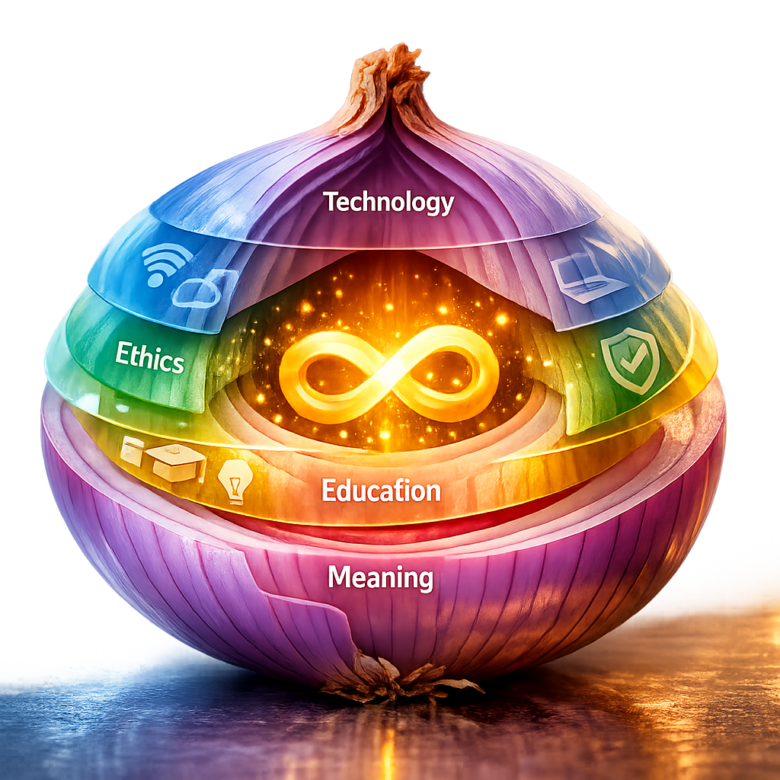
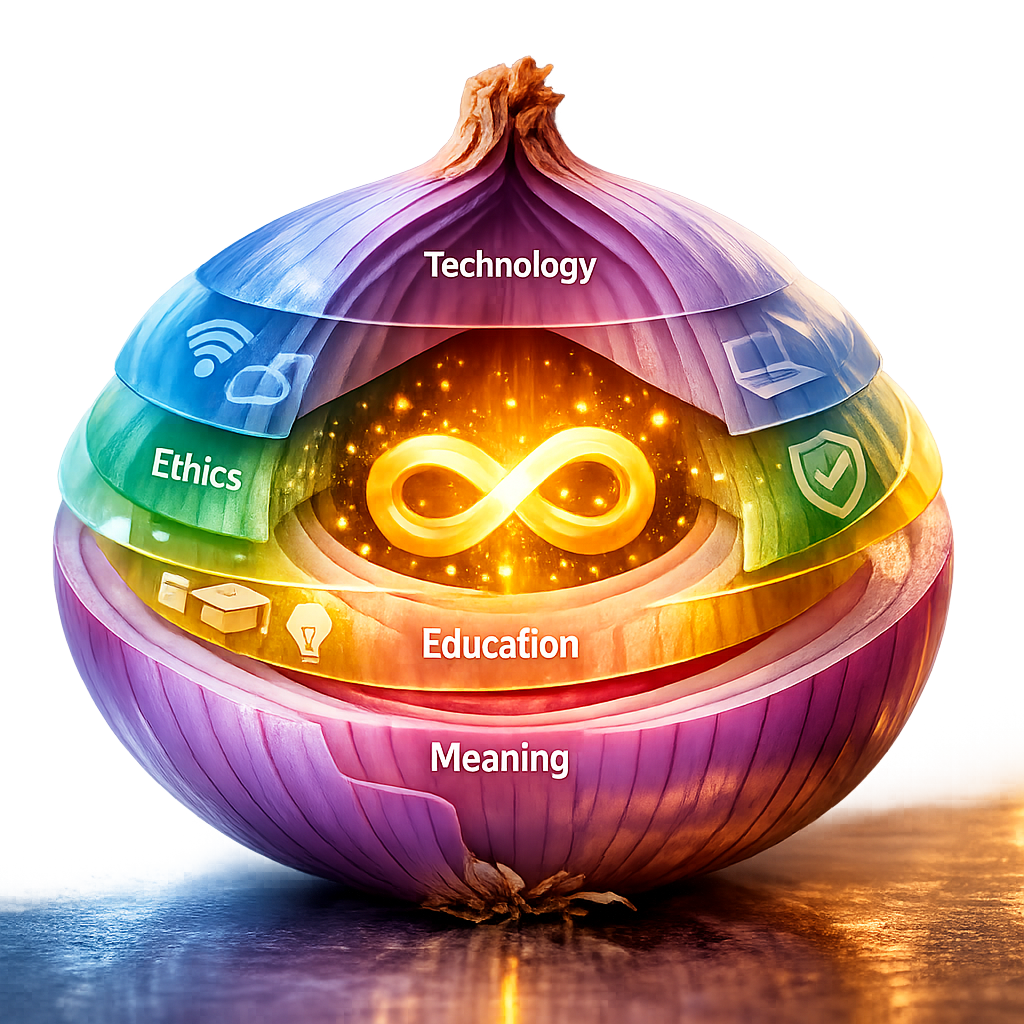
At first, technology looks like a stack of devices and apps. Then you peel one layer and find business models. Peel another and find data. Peel another and find schools, families, governments, workers, loneliness, attention, power, and fear.
That is the infinity onion. Every answer has another layer under it.
The point is not to peel forever until nothing matters. The point is to notice enough layers that your choices become less automatic.
When people talk about artificial intelligence, privacy, automation, or digital learning, they often treat each topic like a single problem with a single solution. It rarely is. A classroom tool can help one student speak up while quietly tracking another student in ways nobody explained. A safety feature can protect a child while giving a company more control over a family’s life. A productivity app can save time while making work feel harder to leave.
The onion does not mean progress is bad. It means progress has roots.
Ethics Starts Before the Policy Document
Ethics in technology can sound formal, like something handled by legal teams and committees. But for most people, ethics starts much earlier. It starts with a pause.
Who benefits if this tool works?
Who pays the cost if it fails?
Who understands what is being collected, changed, predicted, or removed?
Those questions may sound simple, but they slow the room down. That is why they matter.
A turtle pace can be ethical because it resists the pressure to confuse novelty with goodness. It gives people time to look for hidden tradeoffs. It lets a teacher ask whether a new platform serves students or mainly serves reporting. It lets a parent ask whether a device creates safety or dependence. It lets a worker ask whether automation removes dull tasks or quietly removes bargaining power.
Education Is Not Just Training
One of the strangest things about the tech world is how often education gets reduced to training. Click here. Use this prompt. Learn this dashboard. Keep up.
Training has its place. Nobody wants to stare at a tool with no idea where the buttons are. But education is bigger than instruction. Education gives people the confidence to ask why the tool exists at all.
A well-educated user is not someone who knows every feature. It is someone who can notice a pattern, name a risk, and decide when not to use something.
What slower learning can protect
- Attention: You stop treating every notification as an assignment.
- Memory: You remember how things were done before the tool arrived, which helps you judge whether the new way is better.
- Agency: You keep the right to choose a method, not just follow a default.
- Trust: You become harder to impress with vague promises.
The person who learns slowly may remember more because they built a map instead of memorizing a route.
Protection Is More Than Passwords
When people hear digital protection, they usually think of strong passwords, two-factor authentication, backups, and maybe antivirus software. Those are useful. Keep them.
But protection also means protecting your future self from decisions made too quickly. It means protecting children from being profiled before they understand what a profile is. It means protecting workers from systems that measure everything except the human cost of being measured.
Some forms of protection are boring, which is why they work. Read the settings. Question the default. Keep copies of your own work. Do not connect every account just because the app asks nicely. Say no to features that solve a problem you do not have.
There is also emotional protection. You do not have to turn every moment of uncertainty into shame. Not knowing is not a character flaw. It is a signal to slow down and look closer.
Technology Should Serve a Human Shape
The best tools fit the shape of a life. They do not demand that the life shrink to fit the tool.
This is easy to forget because technology often arrives with its own rhythm. It wants updates, permissions, subscriptions, settings, passwords, migrations, and attention. It can start as help and become a small landlord in the corner of your mind.
A turtle has an advantage here. A turtle notices weight. If something adds too much weight, the turtle feels it.
That question is worth asking often: What weight did this add?
Maybe a tool saves three hours a week. Good. Maybe it also makes you reachable at night, easier to monitor, and less patient with people who need time. That does not make the tool evil. It makes the tool complicated.
Meaning Is the Layer People Skip
Under the practical questions sits a quieter one: What kind of person is this technology asking me to become?
That question can feel too soft for a serious tech discussion. I think it may be the most serious one.
If a tool trains me to skim instead of read, that changes me. If a platform rewards outrage, that changes a community. If a system makes care work invisible because it cannot measure it neatly, that changes what an institution values.
Meaning is not decoration. It is the reason any of this matters.
A Practical Turtle Method
Moving slowly does not mean refusing change. It means building a small method for meeting change without losing your footing.
- Name the promise. What does this tool claim it will make easier, faster, safer, or cheaper?
- Name the tradeoff. What does it ask for in return, such as data, attention, money, skill, control, or trust?
- Test it in a small place. Try it on a low-risk task before moving important work or relationships into it.
- Ask who is missing. Who was not considered when this tool was designed or adopted?
- Keep an exit path. Know how to leave, export, delete, or replace it before you depend on it.
- Revisit the decision. A good choice last year can become a bad fit after the tool, company, or context changes.
This method will not make every decision easy. It will make fewer decisions feel accidental.
The Turtle Is Not Behind
The turtle is often framed as slow, but slow is not the same as lost. Sometimes slow is how you stay honest. Sometimes slow is how you protect people who are not in the room when decisions get made.
The fast tech world is not going to stop spinning. There will be more tools, more claims, more dashboards, more warnings, and more shiny objects with serious consequences tucked inside them.
You do not have to match that speed to belong in the conversation. You can move carefully, ask plain questions, protect what matters, and keep peeling the infinity onion without pretending you have reached the final layer.
That may be the turtle’s quiet gift. It reminds the rest of us that the road is not only about arriving first. It is also about noticing what we are carrying, who we are crossing with, and what we might crush if we rush.